How to find the right HS code for your product
Bruce·25 Feb 2026·8 min read
Getting the HS code wrong on an import declaration is one of the most common and most expensive mistakes in international trade. The wrong code means the wrong duty rate, the wrong FTA eligibility, possibly the wrong biosecurity treatment, and a potential audit from ABF that covers every shipment you've lodged under that classification.
The Harmonised System isn't complicated once you understand how it's structured. But it does require precision, and the right classification isn't always obvious. A stainless steel water bottle isn't classified under "bottles" or under "stainless steel." It's classified under "table, kitchen or other household articles" (HS 7323). That's the kind of thing that trips people up.
How the HS system works
The Harmonised System is maintained by the World Customs Organization (WCO) and used by over 200 countries. The first 6 digits are universal. Australia adds two more digits for national purposes, giving us an 8-digit tariff code.
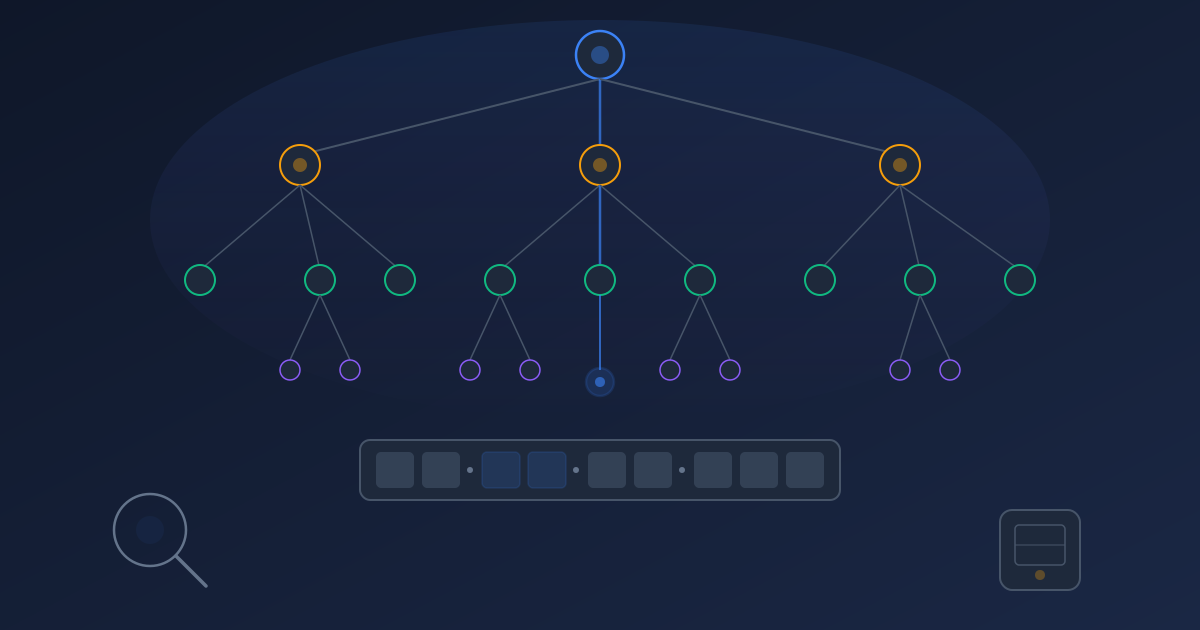
The structure breaks down like this:
- Chapter (2 digits): Broad product category. Chapter 85 is electrical machinery. Chapter 61 is knitted clothing. Chapter 20 is prepared vegetables and fruit.
- Heading (4 digits): Narrower category within the chapter. 8518 is microphones, loudspeakers, and amplifiers. 6109 is t-shirts and singlets.
- Subheading (6 digits): Specific product type. 8518.22 is multiple loudspeakers in a single enclosure. 6109.10 is cotton t-shirts.
- National lines (8 digits): Australia-specific detail. These determine the exact duty rate and statistical reporting.
There are 97 chapters, roughly organized from raw materials (Chapters 1-24 cover animals, plants, and food) through processed materials (25-40 cover minerals, chemicals, plastics) to finished goods (84-97 cover machinery, vehicles, instruments, and miscellaneous).
You can browse the full Australian tariff schedule chapter by chapter to find where your product fits.
The General Interpretive Rules
When the classification isn't obvious, customs authorities apply six General Interpretive Rules (GIR) in order. You don't need to memorize all of them, but understanding the first three covers 90% of real-world situations.
GIR 1: The terms of the headings and section/chapter notes determine classification. This is the starting point. Read the heading descriptions literally. If a heading says "articles of iron or steel," it means articles made of iron or steel. The section and chapter notes at the start of each section provide critical exclusions and definitions. Always read them.
GIR 2(a): Incomplete or unassembled goods are classified as the complete article. An unassembled bicycle shipped in parts is still classified as a bicycle (8712), not as a collection of tubes, chains, and wheels. This also covers goods that are "essentially complete," meaning they need only minor finishing.
GIR 2(b): Mixtures and combinations of materials are classified by the material that gives the goods their essential character. A leather handbag with textile lining is classified as a leather article (4202) because the leather gives it its essential character, even though it contains textile.
GIR 3: When goods could fall under two or more headings. This rule provides tie-breakers. The most specific description wins over a general one. If that doesn't resolve it, essential character determines classification. If that doesn't work either, the heading that comes last numerically wins.
In practice, most classifications are resolved by GIR 1 alone, just by reading the heading descriptions carefully and checking the chapter notes for exclusions.
Worked example 1: electronics
You're importing a portable Bluetooth speaker with a built-in LED light. Where does it go?
Start with what the product primarily does. It's a loudspeaker. Chapter 85 covers electrical machinery and equipment. Heading 8518 covers microphones, loudspeakers, headphones, earphones, and amplifiers.
Within 8518, subheading 8518.22 covers "multiple loudspeakers, mounted in the same enclosure." If your speaker has two or more drivers (most do, even small ones), this is the right code. If it genuinely has only a single driver, it's 8518.21.
What about the LED light? GIR 3(b) says classify by essential character. The product is marketed and used primarily as a speaker. The light is a secondary feature. So it stays in 8518, not in Chapter 94 (lighting).
The full Australian tariff code for this product is 8518.22 with a general duty rate of 5%, reduced to 0% under several FTAs including ChAFTA (China) and JAEPA (Japan).
Worked example 2: clothing
You're importing women's dresses made from a polyester-cotton blend (60% polyester, 40% cotton). The classification depends on the fabric composition and construction method.
First question: is the dress knitted or woven? Check your supplier's fabric specification. If it's jersey, rib, interlock, or any stretch fabric, it's knitted (Chapter 61). If it's poplin, twill, satin, or any flat fabric, it's woven (Chapter 62).
Let's say it's woven. Chapter 62, heading 6204 covers women's suits, ensembles, jackets, dresses, skirts, and trousers. Subheading 6204.43 is specifically "dresses of synthetic fibres." Since polyester (the dominant fibre at 60%) is a synthetic fibre, this is the correct classification.
Not 6204.42 (dresses of cotton), even though the garment contains 40% cotton. GIR 2(b) says the dominant material gives the essential character. 60% polyester means it's classified as synthetic.
The full code under the Australian tariff would be in the 6204.43 range, with a general duty rate of 5%.
If you're not sure about the fibre composition or construction method, ask your supplier for a fabric test report or at least a clear specification. Getting "cotton" wrong when it's actually a polyester-cotton blend changes the classification.
Worked example 3: food products
Food classification is where the HS system gets interesting because the same product can fall in different chapters depending on how it's been processed.
Take coconut. Fresh coconuts are in Chapter 8 (edible fruit and nuts), specifically 0801.12 (coconuts, in the inner shell). Desiccated coconut is still in Chapter 8, at 0801.12. But coconut milk (the liquid extracted from the flesh) jumps to Chapter 20 (preparations of vegetables and fruit), at 2008.19. Coconut oil is in Chapter 15 (animal or vegetable fats), at 1513.11. Coconut water (the natural liquid inside the coconut) is in Chapter 22 (beverages) if packaged for retail sale.
The same raw material, five different chapters depending on processing. This is why classification by "what it is" fails and you need to classify by "what it is as presented for import."
For food products, the chapter notes are critical. Chapter 20 Note 1 excludes vegetables and fruit prepared or preserved by processes specified in Chapters 7, 8, or 11. So if your coconut product is simply dried, it stays in Chapter 8. If it's been cooked, sugared, or otherwise prepared, it moves to Chapter 20.
Common classification mistakes
Classifying by use instead of by nature. A stainless steel water bottle used for sport isn't classified under "sports equipment" (Chapter 95). It's classified under "table, kitchen or household articles of iron or steel" (7323) because the HS system classifies by what the product IS, not what it's used for. There are exceptions (like tools, which are classified by use), but the default is classification by composition and form.
Ignoring chapter notes. Chapter 84 (nuclear reactors, boilers, machinery) Note 5 defines "automatic data-processing machines" with specific criteria. If your device doesn't meet those criteria, it can't be classified in heading 8471, even if everyone calls it a "computer." The notes override common understanding.
Confusing parts with accessories. Parts of machines are generally classified with the machine they belong to (GIR 2(a)). But accessories are often classified separately. A laptop bag isn't a "part" of a laptop, it's classified under 4202 (trunks, suitcases, bags). The distinction matters because parts often get the same duty rate as the complete article, while accessories may have a different rate.
Multi-function products. A printer-scanner-copier (multifunction device) could be classified as a printer (8443), a scanner (8471.60), or a copier (8443). GIR 3(b) says classify by essential character. In practice, ABF generally accepts 8443.31 for multifunction devices, classifying them by the printing function. But if the device is primarily a scanner with a minor print function, the classification could differ.
Sets and assortments. A gift basket containing wine, cheese, crackers, and chocolate isn't classified as "gift basket." Each item has its own HS code. But GIR 3(b) allows sets put up for retail sale to be classified by the item that gives the set its essential character. If the wine is the dominant item by value and intent, the whole set could be classified under 2204 (wine). This is a judgment call and customs brokers regularly disagree on it.
When to get a formal ruling
If the duty difference between two possible classifications is significant, or if you're going to import the same product repeatedly, apply for a Tariff Advice from ABF. It's free, takes 30 days, and gives you a binding ruling that protects you from reclassification later (as long as your goods match the description you provided).
Tariff Advices are particularly valuable for:
- Products that sit on the boundary between two headings
- New or novel products that don't fit neatly into existing categories
- Products where the duty rate differs significantly between possible classifications
- High-volume imports where even a small rate difference adds up
You can search for existing Tariff Advices on the ABF website to see how similar products have been classified. Often, someone has already asked about a product like yours.
Try it yourself
The HS code classifier lets you describe your product in plain English and get a suggested classification with the applicable duty rate and FTA preferences. It's useful for getting a starting point, especially if you're not familiar with the tariff schedule structure.
For browsing the full schedule, the Australian tariff directory lists all 97 chapters with search. You can drill down from Chapter 85 (electrical machinery) to individual headings to see exact duty rates and FTA columns.
Classification isn't something you do once and forget. Products change. Suppliers change materials. FTAs add new preferential rates. Review your classifications periodically, especially when a supplier changes the product specification, and keep your Certificates of Origin current. A correct HS code is the foundation that every other customs calculation is built on.
See it work on your documents
Forward a commercial invoice or bill of lading to your StarShipper inbox — every field extracted and validated in seconds.